Alabama DUI Attorneys
The Polson Law Firm
The Polson Law Firm





A DUI arrest in Huntsville or Madison County is charged under Alabama's statewide DUI law, driving under the influence. The court that hears your case depends on which agency made the arrest. Talking with a DUI lawyer in Huntsville, AL is a smart first step. A DUI attorney can walk you through the local court process.
Huntsville Police Department arrests inside the city limits are usually heard in Huntsville Municipal Court. Under Alabama law, municipal courts hold concurrent jurisdiction with district courts over state law violations within the city's police jurisdiction that may be prosecuted as breaches of municipal ordinances. So a city officer's DUI arrest generally starts in municipal court.
Arrests by the Madison County Sheriff's Office, state troopers, or other state agencies are prosecuted in Madison County District Court. That holds anywhere in the county. These cases follow the county where the offense took place, consistent with the venue statute.
Felony DUI charges – such as a fourth or subsequent offense – move to Madison County Circuit Court. Appeals from Huntsville Municipal Court or Madison County District Court are also heard there. The right venue shapes your defense from the start. Our guide to where an Alabama DUI case is heard walks through each court.
This is the most urgent issue after any Alabama DUI arrest. Under Alabama law, you have 10 days from the Notice of Intended Suspension to request an administrative hearing on the license suspension with ALEA. A request for a hearing does not stay the license suspension. Missing this deadline waives your right to an administrative hearing and to judicial review.
The license suspension runs separately from the criminal DUI case. Even if the criminal charge is reduced or dropped, the suspension can still take effect. That happens when no hearing was asked for within the 10-day window.
When Polson & Polson, P.C. takes on a Huntsville client, the firm gathers the Notice of Intended Suspension and the arrest paperwork fast. It then writes the hearing request and sends it to ALEA's Driver License Division in Montgomery. The request can go by mail (postmarked within 10 days) or by hand delivery. Under the same statute, the hearing must be scheduled within 30 days of the request.
At the ALS hearing, only two issues matter. The first is whether the driver drove or had actual physical control of a vehicle. The blood alcohol level must be 0.08 percent or more. The second is whether the driver refused a chemical test. Polson & Polson, P.C. represents clients at these hearings. The firm tests the proof ALEA leans on, starting with the arresting officer's sworn report.
If the outcome goes against you, Alabama law allows judicial review. You must file a petition in the circuit court of the county where the arrest took place. You have 30 days from the agency's final determination.

Alabama's DUI penalties climb with each later conviction. The tiers below are set by Alabama law. The sentence in any one case turns on the facts, within the ranges the statute sets.
First Offense: A first DUI is a misdemeanor. The statute sets a fine of not less than $600 and not more than $2,100. It allows up to one year in jail, or both. It also sets a 90-day license suspension. That suspension is stayed if the driver installs an approved ignition interlock device for 90 days. Four things make the interlock mandatory for one year: a refusal, an injury, a child under 14 in the car, or a result of 0.15 percent or more.
Second Offense: A second conviction within the lookback period carries a fine of not less than $1,100 and not more than $5,100. Jail may run up to one year. The sentence must include at least five days in jail or 30 days of community service. That part cannot be suspended or probated. The license revocation period is one year. An ignition interlock device is required for two years.
Third Offense: A third conviction carries a fine of not less than $2,100 nor more than $10,100. The jail term runs not less than 60 days nor more than one year. A minimum of 60 days cannot be probated or suspended. The license revocation period is three years. An ignition interlock device is required for three years.
Fourth or Subsequent Offense: A fourth conviction is a Class C felony. This also applies if you have a previous felony DUI conviction. The statute sets a fine of not less than $4,100 and not more than $10,100. The prison term runs not less than one year and one day nor more than ten years. A mandatory minimum of ten days must be served in county jail. The license revocation period is five years. An ignition interlock device is required for four years.
Some facts push the penalties up. A blood alcohol level of 0.15 percent or more requires a sentence of at least double the minimum punishment. The same doubling applies when a child under 14 was a passenger and the driver was over 21. A refusal sets the ignition interlock period at one year. Every case is different. The facts drive how the court applies these rules.
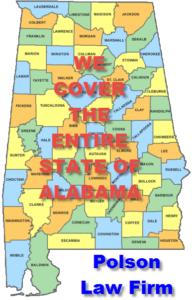
Polson & Polson, P.C. is based in Birmingham and defends DUI cases in all 67 Alabama counties. Huntsville and Madison County are part of that practice. The firm's attorneys travel to defend DUI charges in municipal, district, and circuit courts. DUI lawyers in Huntsville, AL work in all three of those courts.
A Huntsville case begins with a call. The firm offers a free consultation, by phone around the clock or through the contact form on this site. An attorney goes over your situation, your court dates, and your license deadlines. If you need a DUI attorney for Huntsville, AL charges, the firm handles those cases from Birmingham.
A Madison County DUI lawyer has to be ready for whichever court holds the case. That may be Huntsville Municipal Court, Madison County District Court, or Madison County Circuit Court. The firm's attorneys travel to Huntsville for required appearances in those courts.
Whether a DUI case is heard in Huntsville Municipal Court or Madison County District Court, the elements the state must prove are the same. The defense review is similar in each venue, even though court routines differ.
Several issues come up again and again in Alabama DUI cases, no matter where they are heard.
Traffic Stop Legality: The Fourth Amendment requires an officer to have reasonable suspicion before making a traffic stop. If the stop lacked a valid basis, the evidence gathered after it may be suppressed.
Probable Cause for a DUI Arrest: After the stop, officers must build probable cause before making a DUI arrest. What the officer saw, what the driver said, and how the car was driven all feed into that call.
Field Sobriety Tests: These tests are meant to be given under set rules. Uneven pavement, poor light, bad weather, and health problems can all hurt how a driver performs. Each one can call the results into question.
Breath Test Challenges: Under Alabama law, chemical analyses must be performed according to methods approved by the Department of Forensic Sciences. The test must also be run by someone holding a valid permit from that department. Machine calibration records and operator permits are where many defense challenges start.
Blood Draw Chain of Custody: When blood is drawn at a law enforcement officer's direction, only a physician, registered nurse, paramedic, phlebotomist, or other qualified person may withdraw it. Gaps in the chain of custody can affect whether the results come in. So can steps that were skipped.
Implied Consent and Refusal: Turning down a chemical test carries its own cost. The refusal can be used as evidence. But the implied consent warning, and how the refusal happened, may open defense arguments.
A Huntsville DUI attorney who knows Alabama DUI law can judge which of these issues fits a given case.
The court depends on the arresting agency. Huntsville Police Department arrests are typically prosecuted in Huntsville Municipal Court. Arrests by the Madison County Sheriff, ALEA troopers, or other state agencies go to Madison County District Court. Felony DUI charges and appeals are heard in Madison County Circuit Court. An attorney can confirm the right venue from your arrest paperwork.
Under Alabama law, you have ten days from the date of the Notice of Intended Suspension to submit a written request for an administrative hearing to ALEA. Missing this deadline waives your right to an administrative hearing and to judicial review. Call a lawyer right away to protect that right.
Ask which court your case is in and how often the lawyer appears there. Ask who will handle the 10-day license request and when it will go out. Ask how the firm keeps you posted on court dates and what the fee covers. Ask whether the lawyer has read the arrest paperwork before quoting a plan. Those four answers tell you most of what you need to know.
A first DUI is a misdemeanor under Alabama law. A first DUI carries potential jail time, fines, license suspension, and possible ignition interlock requirements. The sentence depends on the facts of your case and on any aggravating factors. Talk with an attorney about how the statute applies to your situation.
Yes, Alabama attorneys licensed by the state bar may practice in any Alabama court. Polson & Polson, P.C. handles DUI cases statewide from its Birmingham office, in all 67 Alabama counties. The firm's attorneys travel to Huntsville Municipal Court and Madison County courts for required appearances.
A fourth DUI conviction is a Class C felony under Alabama law. This also applies if you have a prior felony DUI conviction. The statutory lookback period for counting prior convictions is ten years, but a prior felony DUI conviction counts no matter when it occurred. A felony DUI carries imprisonment of not less than one year and one day.
If you were arrested for DUI in Huntsville or Madison County, the 10-day deadline to request an ALS hearing is already running. Acting fast is the only way to protect your right to challenge the license suspension.
Polson & Polson, P.C. offers a free consultation by phone, around the clock, to Huntsville and Madison County residents. On that call, an attorney can go over your Notice of Intended Suspension and your arrest paperwork. That call is also the place to ask what comes next in your case.
Every case is different. Results depend on the facts involved. Contact Polson & Polson, P.C. to discuss your DUI charge and your options under Alabama law.